

Illegitimate children have always been a subject of debate in many countries. They were usually doomed to a scornful attitude from society and a dubious future. This issue was also relevant in 18th-century England. Most of these children lived in the West Indies because the British colonisation involved a lot of slaves. Such a fate awaited Dido Elizabeth Belle, but the girl was brought to London. Why did she become a gentlewoman and what obstacles did she encounter on her life path? Learn more at londonka.
The beginning of her story
First of all, we should describe the stories of Dido Elizabeth Belle’s parents to better understand her life path and the attitude of society at that time towards such people. Her mother was a dark-skinned slave, but the status of her father contributed to the fact that the girl was brought up in the environment of aristocrats. John Lindsay was a naval officer at the time of Dido’s birth. In total, he became the father of five illegitimate children. He met the slave Maria Belle on a captured Spanish ship. Then the girl was only 14 years old, and already at 15, she gave birth to a child. In 1765, when Dido Elizabeth Belle was about four years old, mother and daughter moved to London. The girl grew up in good living conditions, but her father never publicly recognised her as his child. Therefore, Dido Elizabeth Belle took her mother’s surname and wasn’t mentioned in her father’s will.
Further fate and representation in films and books
Dido was brought up at Kenwood House in London. She was accepted by an aristocratic family that also raised a niece (of almost Dido’s age). So, the girls grew up together. In general, Dido Elizabeth Belle had everything characteristic of wealthy families. She was treated well and received an education. She could be called a gentlewoman and a fashion icon, but not the daughter of a slave. However, even the care of the family didn’t neutralise social stereotypes. The girl’s cousin William Murray, 1st Earl of Mansfield (the one who owned Kenwood House) often expressed his opinion about the absurdity of such a phenomenon as slavery. He sometimes helped slaves defend their positions during court hearings. However, the society of that time treated the inhabitants of the colonised territories very badly. People considered them as property and considered that was right. They thought that William Murray’s statements were imposed by a dark-skinned girl living in his house.
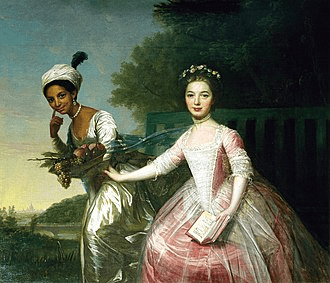
Photo source: Wikipedia
Dido Belle lived at Kenwood House for about 30 years. Due to her origin, she rarely had the opportunity to attend balls and her presence at other social events caused displeasure. In 1793, Dido married a French servant. Later, the couple had three children. The life story of Dido Elizabeth Belle became the basis of many creative works. For example, in 2007, the Queen Elizabeth Hall in London staged the opera trilogy Spirit Songs by Shirley Thompson. In one of the parts, the composer paid great attention to the image of Dido Elizabeth Belle. In 2013, the world saw the film Belle. In the same year, Caitlin Davies published the novel Family Likeness, which was partially based on Dido’s life story. The musical Fern Meets Dido was created five years later. This person is also mentioned in the novel Swing Time, published in 2016. In 2021, the world saw another novel, Dangerous Freedom, which was also based on facts from Dido Elizabeth Belle’s life. In general, her personality remains a subject for discussion and the creation of artistic works even in the modern world.