

Women who managed to achieve success in science or generally influence social processes have always attracted attention. The role of pioneers was especially important. These are the women who, despite the prejudices of society and many obstacles, achieved the desired results. One of them was Ada Lovelace, the only legitimate child of George Byron. Later, she was called the first programmer. What was the woman’s life and what influenced her achievements in science? Learn more at londonka.
A childhood full of illnesses and mathematical interests
Ada Lovelace was born in London on December 10, 1815. Several interesting facts from her life were related to her parents. Although Ada was the only legitimate child of the famous writer George Byron, she hardly knew her father. Six months after the girl was born, he left England for good. Moreover, he was waiting for his son. Ada was only eight years old when her father died. So, the upbringing of the child fell on the shoulders of the mother, who was an educational reformer and philanthropist. However, their relationship wasn’t too close either. The girl spent a lot of time with her grandmother. Ada Lovelace’s childhood was full of illnesses. At the age of eight, she suffered from headaches. Even though it greatly affected the girl’s vision, she was a fairly intelligent child. Her mother hated everything that had to do with Byron, so she taught her daughter mathematics. At the age of 12, Ada started to develop her own flying device, and a year later, she managed to recreate wings. Working on that project, the girl read many books and even studied the anatomy of birds. Around the age of 14, her life changed due to measles. The disease deprived her of the ability to move for a long time. In general, there were quite a few epidemics in London during that period of history.
Education and scientific achievements
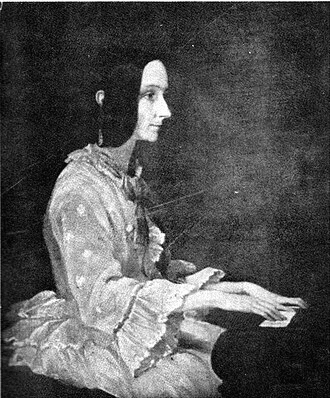
Photo source: Wikipedia
The girl developed a more serious passion for mathematics when she was 17 years old. She became very interested in science, which led to a meeting with the famous English inventor Charles Babbage. In 1833, he invited Ada Lovelace to look at his prototype of the difference engine. Then she began to describe the functions of the analytical engine. Although, at first, only a few publications showed interest in her works and the girl had to explain all the mechanism principles in simpler language, later they became some of the most famous in the world. Her notes and translation of the article from the Italian language became a subject for discussion and research by other scholars. In particular, some assumptions about artificial intelligence were later refuted by Alan Turing. These notes, which can be called a separate scientific work, played an extremely important role in the development of computer science. One such note contained a machine algorithm, something similar to modern computer programmes. Ada Lovelace devoted a large part of her life to the study of computing. However, she also paid attention to the application of mathematics in other fields of science. In particular, the scientist tried to establish the relationship between the psyche and computational processes. In 1844, she began to implement a project related to this topic and even learned to conduct electrical experiments. In the last years of her life, she also studied the connection between mathematics and music. However, most of her works remained drafts. Ada Lovelace died of uterine cancer in 1852.