

History has seen many periods when a woman hasn’t been perceived as a full member of society. Even the modern world is full of stereotypes. For quite a long time, a woman’s role was to keep the household and raise children. Women have achieved a more respectful attitude in society relatively recently. Such changes were facilitated by a powerful women’s movement that swept through many countries of the world (especially Europe). Similar organisations were created in London as well. The city has a fascinating suffragette history. This movement became very popular in the 20th century. What are the main features of this social phenomenon and did the women of London manage to achieve what they wanted? Learn more at londonka.
Prerequisites for the emergence of the global women’s movement
In general, the resistance of British women was a result of events that had been taking place in society over many years. It can be compared to lava that boils in a volcano and explodes eventually. In the 19th century, inequality of men’s and women’s rights was present in many spheres of life. Women had lower wages (if they had the opportunity to work at all), scientific degrees were also granted only to men and, in general, it was quite difficult to meet a woman in the medical or political fields. The latter caused a global struggle to give women the right to vote. Beginning in 1868, several attempts were made to introduce bills that provided for women’s right to vote. Every year, they were supported by an increasing number of deputies, but they were all rejected by the government.
The emergence of the suffragist movement and its founders
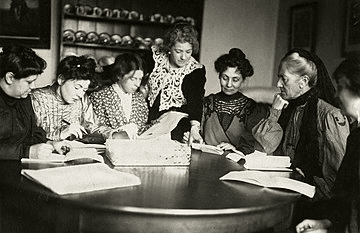
The suffragette movement was part of the Votes for Women campaign, which aimed to fight for women’s right to vote in parliamentary and general elections. Their main tools were debates, art and propaganda, but sometimes representatives of such organisations resorted to attacks on property (including setting fires and breaking windows). It is considered that the movement was started in 1903 when Emmeline Pankhurst and her two daughters founded the Women’s Social and Political Union in Manchester. Soon, the headquarters were moved to London. This organisation, which called for the awakening of the nation to give women the right to vote, gained huge popularity.
The movement spreading and further development of the organisation
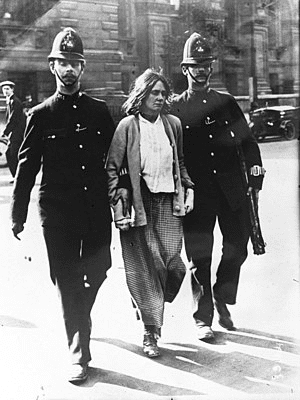
The movement began to spread throughout the country at a frantic pace, but the main activity of the created organisation took place precisely in London. The Women’s Social and Political Union consisted of 90 separate branches throughout Great Britain and their biggest number was in London (34 hubs). The reason was the close proximity to the authorities, which made it possible to achieve the desired faster and more efficiently. Volunteers as well as paid staff from the Women’s Social and Political Union held fund-raising events, called for demonstrations and published a weekly newspaper, Votes for Women. Such activities required a permanent presence in government buildings and it was provided. Women staged protests, shamed deputies and chained themselves to the walls of administrative buildings. However, such actions were stopped due to the beginning of the First World War. Then the main efforts were made to help the military. The government took advantage of the circumstances and decided not to consider the suffragette issue. Despite all the difficulties, the suffragettes achieved what they wanted. In 1928, the Representation of the People (Equal Franchise) Act 1928 was passed, which equalised voting rights for all people aged 21 and over.