

London is celebrated not only for its historical landmarks but also for its deep-rooted fashion traditions. Every century brought changes to motifs and styles, which evolved and created unique designs. Couturiers shaped the visual and cultural heart of the metropolis, as London has always been a place where trends are born.
It was in the capital of Great Britain, at the end of the 19th century, that the first major fashion house emerged. It became a centre of style where the women of London saw clothing displayed not on mannequins, but on living people. Beauty, elegance, and novelty—these were the elements that Lady Duff-Gordon sought to embed in the fashion industry. She was the first British designer to achieve international recognition, pioneering Haute Couture styles and becoming an innovator in fashion public relations. Read more at londonka.uk.
Early Years
Lucy Christiana, Lady Duff-Gordon, born Sutherland, and known to many by her professional name, Lucile, was born on 13 June 1863 in London. Following her father’s death, her mother remarried in 1871, and the family relocated to the island of Jersey. From a young age, the girl adored dressing dolls. She studied the gowns she saw in family paintings and later began sewing clothes for herself and her sister.
In 1884, Lucy married James Stuart Wallace. The couple had a daughter, Esme, but later divorced. Left without an income, Lucy decided to take up dressmaking. She worked from home to support her family. Eventually, in 1893, she opened her first fashion house, “Maison Lucile”, in the heart of London’s fashionable West End, a location that quickly became popular among the city’s elite. Four years later, the couturier opened an even larger shop. It is worth noting that in 1900, Lucy married for a second time to Cosmo Duff-Gordon, a Scottish baronet, landowner, and sportsman.
A dramatic moment in the designer’s life was her rescue from the Titanic. She, her husband, and her secretary were saved in Lifeboat No. 1, which carried only 12 passengers instead of its capacity of 40. Lucile was later called to testify at the inquiry, where she faced public accusations of cowardice and bribery.
Founding “Lucile Ltd”
In 1903, her business was officially registered and named “Lucile Ltd”. The company became the first British fashion house to achieve international recognition. Lucile Ltd catered to wealthy clientele, aristocrats, members of the royal family, and theatre stars. The dressmaking business expanded rapidly, and she began opening other salons. In 1910, the fashion house opened in New York, followed by Paris a year later, and Chicago in 1915. This expansion helped make the original fashion house famous, boasting major branches across three countries.
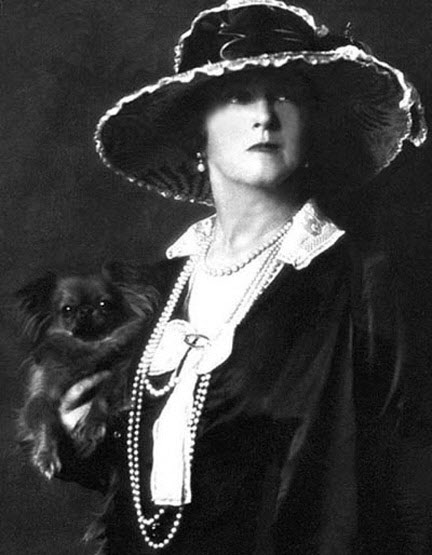
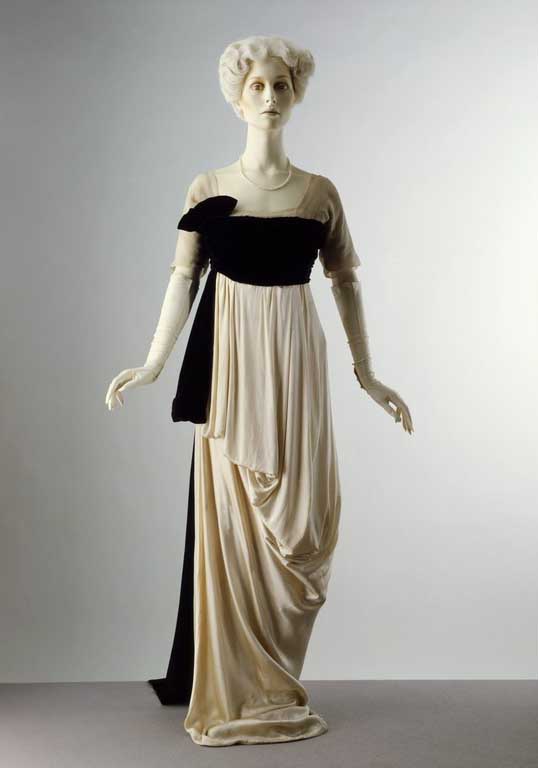
The fashion house was renowned for its collections of lingerie, gowns, and evening wear. Lucile introduced layered draping using soft, pastel-toned fabrics. These were highlighted by a scattering of hand-made silk flowers, which became her signature touch. She also created simpler models for women, alongside men’s suits and daywear. The classic draped style is a defining feature of her designs. Lady Duff-Gordon first developed a draped dress in Paris for the Lucile Ltd Spring 1913 collection and later adapted it for London socialite Heather Firbank. Similar dress models were chosen by actress Kitty Gordon and dancer Lydia Kyasht. An example of the gown is held in the Victoria and Albert Museum.
Lucy Duff-Gordon pioneered the concept of using professional models (mannequins). Live models displayed the designer’s new creations, accompanied by theatrical presentations featuring quality lighting and musical accompaniment. These were the first ‘catwalk’-style shows, and she introduced what she called “emotional dresses.” These garments were named after figures from history, literature, or psychology, and even took the clients’ personalities into account.
Changing the Fashion Industry
The designer’s new tailoring styles and exclusive models undoubtedly brought changes to the entire London and global fashion industry. Early sketches from Lucile Ltd are preserved in the Victoria and Albert Museum archives. They show that in 1904, the salon employed at least one artist to sketch the design developments. Hiring artists was common practice for fashion houses of that era; they produced drawings for each season and for individual clients. Lucy Duff-Gordon frequently observed their work, offering critique, adding notes and signatures, and ultimately approving the designs.
The founder of the fashion house created sketches that followed the shape of the human body. Her surviving sketchbooks in the archives demonstrate minimal drawing skill but an excellent ability to convey colour. She promoted her collections through magazines, newspaper columns, and articles. Her models frequently appeared in Vogue, Femina, Les Modes, and L’art et la Mode.
She also mastered commercial promotion, creating her own name for advertising perfumes, lingerie, shoes, beautiful clothing, and jewellery. A particularly bold venture was a two-season, inexpensive mail-order clothing line for Sears, Roebuck & Co, selling her designs through their catalogues.
Impact and Legacy
Lucy Duff-Gordon revolutionised women’s underwear by freeing them from restrictive, heavy corsets. She left a significant and lasting impact on the London fashion industry. Her ideas marked the beginning of modern fashion shows, setting high standards for female elegance. The designer was the first to establish a professional fashion house in London.