

Probably, everybody knows that for a long period, women didn’t have the right and opportunity to engage in science. However, some of their theories, research and inventions surpassed the men’s ones. British scientific history is full of such cases. Unlike other countries, Great Britain was a more favourable place regarding the granting of such a right to a woman. However, women gained full freedom and respect in society only at the end of the 20th century. London can boast of many unsurpassed scientists. Rosalind Franklin was one of them. What was the life of this chemist and why did she become famous all over the world? Learn more at londonka.
Origin and first interest in science
Rosalind Franklin was born in London on July 25, 1920. Perhaps, her origin allowed the young girl to get the opportunity to study science. Rosalind was born into a wealthy Jewish family. Her father was a merchant and London banker. Her uncle was famous for being the first Jew to serve in the British Cabinet. In 1916, he was appointed the Home Secretary. In general, little Rosalind Franklin had a happy and secure childhood and showed great interest in science. She was especially interested in natural phenomena and their origin. At first, she studied at St. Paul’s Girls’ School and was quite successful at her studies. She paid particular attention to Latin and natural sciences, but also was good at sports. In 1938, she entered the college of the University of Cambridge to study chemistry. In 1941, the girl passed the exams but didn’t receive a scientific degree because at that time women weren’t given such an opportunity. Rosalind Franklin was awarded PhD at the University of Cambridge in 1945.
Achievements and difficulties in scientific activity
Rosalind Franklin made one of the first significant steps in science during the Second World War. She decided to make her knowledge useful. In August 1942, the scientist began working at the British Coal Utilisation Research Association. Rosalind Franklin devoted her study to the porous structure of coal. After that, she wrote her doctoral thesis, which became the impetus for the idea of extraordinarily strong carbon fibre.
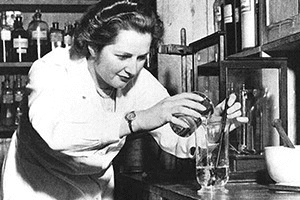
Among Rosalind’s numerous scientific works, her research on the DNA structure brought her the greatest fame. She began to study this topic in 1951. Then Rosalind Franklin became a research fellow at the Medical Research Council at King’s College London. Her main task had to be the analysis of fats and proteins in solution. However, the scientist began to study DNA, as she had experience in the field of diffraction analysis. During her scientific activities, Rosalind repeatedly encountered discrimination, which was quite common at that time. Women were far in the minority in this sphere. So, Rosalind got used to inequality. However, she had a rather strong character and behaved confidently and decisively. Apparently, these qualities helped her achieve success. Long-term research allowed her to discover that there are two forms of DNA. She got the image using X-ray diffraction. Then the scientist was engaged in research on the poliomyelitis virus. Later, she became interested in the tobacco mosaic virus. Rosalind Franklin’s scientific career was very eventful but too short, as she died in 1958 of ovarian cancer.