

London’s history is filled with remarkable women who shaped the development of Great Britain. Among them, Margaret Thatcher is one of the city’s most famous figures, her name having become a symbol of political change. She was the first woman to hold the office of Prime Minister of the United Kingdom, proving that women could also master the world of politics. Read more at londonka.
Margaret Thatcher’s career was brilliant: she succeeded in transforming many aspects of British domestic and foreign policy and revitalised the economy. In the process, she and Ronald Reagan became key figures in a new school of conservative thought that had a powerful influence on politics in both the US and the UK.
Childhood and Youth
Margaret Roberts, later Margaret Thatcher, was born on 13 October 1925 in Grantham, Lincolnshire. Her father owned a tobacconist’s and a grocery shop. She attended a local state school before gaining a place at Oxford University to study chemistry. Regarded by her tutors as a diligent student, she also became President of the Oxford University Conservative Association. After the Second World War, she worked as a research chemist but maintained a keen interest in politics.
In 1950, Margaret Roberts stood for Parliament in the constituency of Dartford. She was unsuccessful, but in the following year’s election, she increased her vote share, gaining more votes than previous Conservative candidates in the area.
Work in Parliament
In 1951, Margaret Roberts married Denis Thatcher, a wealthy businessman. She gave birth to twins, Mark and Carol, while simultaneously studying for her bar exams, which she passed in 1954. Afterwards, she practised as a barrister while searching for a winnable seat. In 1959, she stood for Parliament again in the Finchley constituency and easily won the seat. Her first private member’s bill was to grant the media the right to report on local council meetings.
In 1961, Margaret Thatcher was appointed Parliamentary Under-Secretary at the Ministry of Pensions and National Insurance. She steadily climbed the career ladder and later became Secretary of State for Education and Science. In 1975, she defeated former Prime Minister Edward Heath to become the leader of the Conservative Party.
The “Iron Lady”
Just four years later, in 1979, Margaret Thatcher became the Prime Minister of Great Britain, the first woman to hold the position. She drove forward major economic reforms that changed the country. By championing a reduced role for the state in the economy, privatisation, and support for entrepreneurship, she earned the nickname the “Iron Lady.”
Thatcher became one of the most influential women in the world, but her policies involved tough measures, such as cutting public spending, confronting the trade unions, and reducing taxes. These reforms helped stabilise the country’s economy but also led to major protests. While they helped overcome economic stagnation, they were also criticised for increasing inequality and unemployment.
Second Term
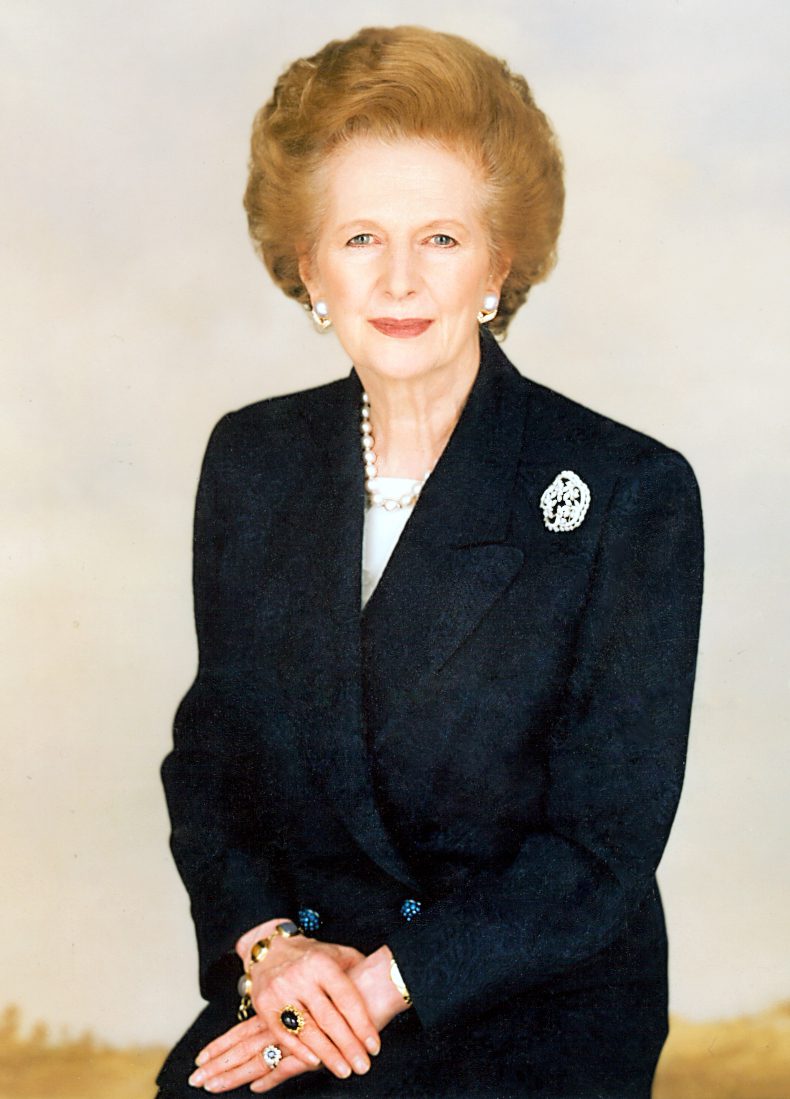
An improving economic situation helped Margaret Thatcher win a second term in 1983. During this period, her government passed legislation requiring trade unions to hold secret ballots before any strike action and refused to make concessions during the miners’ strike. Under her leadership, British Telecom, British Gas, British Airways, Rolls-Royce, and other state-owned companies were privatised.
In foreign policy, Margaret Thatcher was a staunch ally of the United States, working closely with then-President Ronald Reagan. Their partnership became a symbol of the global fight against communism. Her relationship with other European leaders was often strained, as she believed the European Union should be a free-trade area rather than a political project.
Final Years
Margaret Thatcher resigned in 1990, leaving behind a legacy of a revitalised British economy and a strong position on the world stage. However, her reforms also led to increased social inequality and deep divisions in society. Even after leaving office, she remained a significant figure in the Conservative Party, and her advice was often sought and heeded. In 1992, she was granted the title of Baroness and continued her work in the House of Lords.
Throughout her life, Margaret Thatcher was also a prominent lecturer. She wrote two volumes of memoirs, “The Downing Street Years” and “The Path to Power.” After publishing another book, “Statecraft,” she suffered several small strokes and announced her withdrawal from public life. Her husband, Denis, passed away in June 2003, and her own health gradually declined due to memory loss. Margaret Thatcher died on 8 April 2013 in London. Her funeral was held with full military honours at St Paul’s Cathedral.
Thatcher remains a controversial figure in British politics, but her legacy has left an undeniable mark. Her progressive political ideas laid the groundwork for modern governance. Her ability to make unpopular decisions and her unwavering resolve demonstrated that women could be just as strong leaders as men. Margaret Thatcher became an example of how determination and perseverance can change not only a personal destiny but also the future of a great nation.